Gas chromatography mass spectrometry for volatile & semi-volatile organics, unknown compound identification, polymer pyrolysis, and custom method development. ISO 17025 accredited.
Our GC-MS platform supports a broad range of organic analysis modes. Whether you need a regulated compendial method or a custom characterization run, we can accommodate most volatile and semi-volatile matrices.
Identification and quantification of low-boiling organic compounds in liquid, gas, headspace, and solid matrices. Applicable to residual solvents, flavor/fragrance profiling, off-gas analysis, and environmental VOC screening.
Analysis of higher-boiling organic compounds requiring solvent extraction or direct liquid injection. Includes PAHs, phthalates, pharmaceutical process impurities, synthetic intermediates, and lipid-soluble analytes.
Controlled thermal decomposition of solid materials generates characteristic pyrolysate fragments that serve as a chemical fingerprint. Essential for polymer identification, microplastics analysis, and material characterization without solvent extraction.
Full-scan acquisition with NIST 2023 mass spectral library search for compounds without reference standards. Used for process impurity identification, extractable & leachable studies, contamination investigations, and competitive deformulation.
Selected Ion Monitoring (SIM) mode dramatically increases sensitivity and selectivity for known target analytes. Used when compendial or regulated methods require quantitation below full-scan detection limits, such as pesticide residues or environmental monitoring.
For novel analytes, unusual matrices, or applications where no existing compendial method applies, we develop and validate fit-for-purpose GC-MS methods. Deliverables include an optimized method SOP, linearity/recovery/precision data, and a validated limit of quantitation (LOQ).
Our analytical instrumentation is maintained under ISO 17025 quality requirements with traceable calibration, routine performance verification, and documented preventive maintenance.
| Instrument | GC/MS System with Pyrolysis Interface |
| GC Column Types | DB-5ms, DB-1ms, DB-624, DB-WAX, specialty phases |
| Ionization Modes | Electron Ionization (EI, 70 eV); Chemical Ionization (CI) available |
| Acquisition Modes | Full Scan (m/z 10–800+), SIM, alternating scan/SIM |
| Mass Range | 10–800 m/z standard; up to 1200 m/z with configuration |
| Pyrolysis Interface | Filament-type pyrolyzer; 200–900°C programmable temperature |
| Injection Modes | Split/splitless, on-column, headspace, thermal desorption adapter |
| Mass Library | NIST 2023 (350,000+ spectra); custom in-house pyrolysate library |
| Quantitation Range | Low ppb (ng/g) to high % depending on matrix and analyte |
| Calibration Traceability | NIST-traceable reference standards; ISO/IEC 17025 accredited |
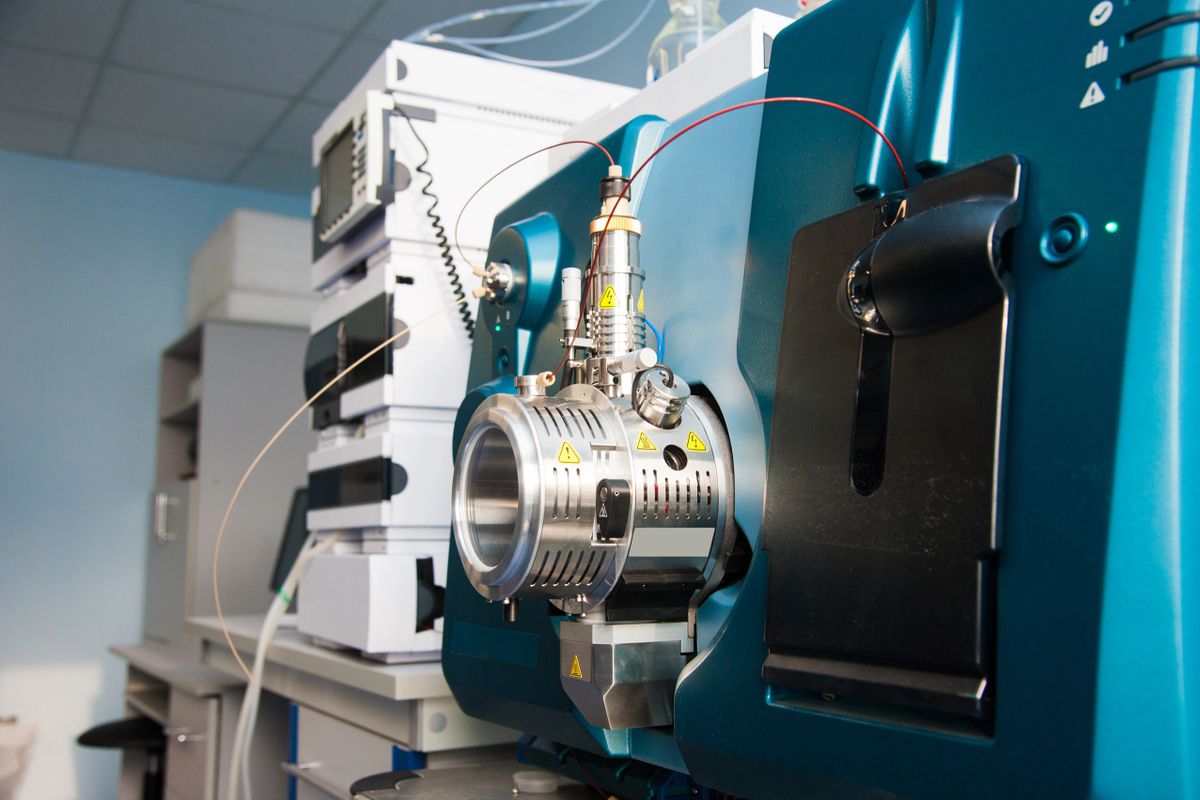
Prodigy Labs GC-MS / Py-GC/MS platform, San Diego
GC-MS and LC-MS/MS serve complementary roles. Knowing which platform fits your analyte class avoids wasted prep time and ensures optimal sensitivity.
| Analyte Property | GC-MS | Py-GC/MS | LC-MS/MS | Best Choice |
|---|---|---|---|---|
| Volatile organics (bp < 300°C) | ✓ Excellent | — | Poor | GC-MS |
| Polymer / solid material ID | — | ✓ Only method | — | Py-GC/MS |
| Unknown compound ID | ✓ NIST library | ✓ Pyrolysate library | Partial (no universal lib) | GC-MS / Py-GC/MS |
| Thermolabile compounds | Avoid | — | ✓ Preferred | LC-MS/MS |
| Residual solvents (USP <467>) | ✓ Compendial | — | Not compendial | GC-FID / GC-MS |
| Pesticides (GC-amenable) | ✓ High sensitivity | — | Partial (some only) | GC-MS/MS or GC-MS |
| PAHs, dioxins, PCBs | ✓ Standard | — | Possible | GC-MS |
| Mycotoxins | Derivatized | — | ✓ Preferred | LC-MS/MS |
| Heavy metals | — | — | ICP-MS preferred | ICP-MS |
Not sure which platform fits your analyte? Email us a brief description and we'll recommend the best approach — no commitment required.
When no existing compendial or published method covers your analyte or matrix, we develop and validate a fit-for-purpose GC-MS method. All method development deliverables are documented for regulatory submission readiness.
We evaluate your analyte's GC-amenability — volatility, thermal stability, response to EI ionization — and recommend the optimal sample preparation and column chemistry. Typical turnaround: 1–3 days with a brief sample description.
We screen stationary phase options (non-polar to polar), carrier gas flow, temperature program, and injection parameters to achieve baseline resolution of target analytes from matrix interferences.
Method performance is validated with calibration curves (5+ points), spike-and-recovery across at least two concentration levels, intra/inter-day precision (RSD%), and a formally established limit of quantitation.
A written method SOP is delivered with all validation data in a format suitable for a regulatory dossier (IND, NDA, ANDA, or supplement documentation). The method can be transferred to a reference laboratory if needed.
GC-MS is one of the most versatile analytical platforms available — virtually any application involving organic compounds at trace-to-percent levels is in scope.
Residual solvents, genotoxic impurities, process impurity ID, extractables & leachables, and degradation product profiling for IND/NDA submissions.
Residual solvent panels (USP <467>), GC-amenable pesticide screens, flavor/terpene profiling, and botanical extract characterization.
Unknown identification from synthesis reactions, metabolite profiling, novel polymer characterization, and exploratory characterization of new materials.
Polymer ID via Py-GC/MS, additive profiling, coating characterization, failure analysis, and competitive deformulation of plastic compounds.
VOC and SVOC screening in soil and water matrices (EPA 8260/8270-series methods), off-gas analysis, and microplastics characterization in environmental samples.
Fragrance and flavor profiling, volatile safety assessment, extractable/leachable studies for packaging, and compliance screening for restricted substance lists.
Every GC-MS analysis includes a complete documentation package. For method development projects, a full validation report is included.
Describe your sample type and what you're trying to learn — we'll recommend the right GC-MS approach and confirm turnaround within one business day.
Email a brief description: sample matrix, analytes of interest (or "unknown — identify everything"), quantity available, and target regulatory standard if applicable. We'll confirm approach and quote same day.
We'll send a sample submission form with sample prep guidance. GC-MS typically requires 1–50 mg of solid or 0.1–5 mL of liquid. We'll advise on container type and shipping conditions to preserve volatile analytes.
Standard turnaround is 5–10 business days. Rush service (2–3 business days) is available. Results delivered as a signed PDF report with full raw data upon request.
Send us a brief description of what you're working with and we'll recommend the right GC-MS approach. No commitment required.